 Daniel
 October 1, 2026
Made in Los Angeles
On MS-13, Barrio 18, and the road through Honduras in Sanctuary
A reader wrote to me recently with a question: “Are the gangs in the novel real, or did you make them up?” I understand why she asked. Some of what happens in those chapters sounds like fiction. It isn’t. The gangs are real, and the story in the book is built from what people who lived there told me about life on the ground. This post is about where those stories came from.
Last year the motor on my garage door died. The man who came to replace it was from Honduras. His English was broken and my Spanish is worse, so we met somewhere in the middle. He worked for most of an afternoon, and while he worked he told me about his journey north and the life he had left behind.
Almost all of it was new to me. At one point he said “MS-13,” and I nodded as if I knew what he meant. Honestly, I thought it was a food additive, or maybe a chemical. He saw that I didn’t understand and explained it patiently, the way you’d explain something to a child.
These were gangs, he said, and they were in every town and every city. You couldn’t get rid of them. In El Salvador, he was close to literally right. By 2018, local governments had lost real control of 248 of the country’s 262 municipalities, and politicians had to ask the gangs’ permission to hold a rally. In his own Honduras, they were strongest in the poor neighborhoods of Tegucigalpa and San Pedro Sula, and from there they reached out along the roads.
That conversation sits underneath a chapter of Sanctuary. When Miles and Elias cross into Honduras, the first thing they see is the welcome sign, pocked with bullet holes. Someone has sprayed MS-13 across the bottom corner.
Two gangs
The two gangs he talked about are the ones in the book.
- MS-13, or Mara Salvatrucha. It has an estimated 30,000 to 50,000 members worldwide, and 8,000 to 10,000 of them are in the United States.
- Barrio 18, also called the 18th Street gang. It has an estimated 30,000 to 50,000 members across the United States, Mexico and Central America.

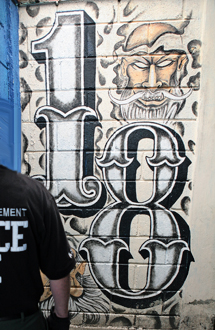


They are bitter rivals. MS-13 alone reaches across El Salvador, Honduras, Guatemala, Mexico, the United States, Canada and Spain. Their income comes from extortion, drug and weapons trafficking, kidnapping, robbery and murder. Their main business is extortion, the renta. A shopkeeper, a bus driver or a family selling tortillas from their front window pays a weekly fee to keep operating, and to stay alive. InSight Crime’s profiles of MS-13 and Barrio 18 describe how this works.
The people who feel it most are not drug buyers in faraway countries. They are the gangs’ own neighbors.
Born in LA
This is the part that surprised me most. When we hear about these gangs, we picture something foreign that grew up somewhere far away, and we don’t give it a second thought. But both of them started in Los Angeles.
Barrio 18 formed in the Rampart District in the 1960s. Its founders were Mexican-American and other immigrant kids who weren’t accepted into the existing neighborhood gangs. MS-13 formed in Pico-Union in the 1980s, among Salvadoran families who had fled the civil war at home. Their children were trying to survive the streets of a strange city.
Then the United States deported them. After El Salvador’s civil war ended in 1992, large numbers of gang members were sent back to El Salvador, Honduras and Guatemala. Those countries were poor, worn out by war, and had little capacity to absorb them. The gangs took root there and grew far beyond anything they had been in Los Angeles. A problem made on American streets was exported, and years later it came back as a reason people were fleeing north.
The crackdown
For a long time, nothing worked. In 2015 El Salvador had 103 homicides per 100,000 people, the highest rate in the Western Hemisphere.
In March 2022, after a weekend of mass killings, the government declared a state of exception. It was supposed to last thirty days. As of September 2026, it has been extended 55 times. The order allows arrests without a warrant, stretches the time a person can be held without charge from three days to fifteen, and lets the government monitor private communications. More than 93,000 people have been arrested. Soldiers sealed off neighborhoods and made men strip so they could be checked for tattoos. Honduras followed with its own in December 2022.
And it worked, in the way it was meant to. Neighborhoods that had been held hostage for a generation are quiet. People ride buses and open shops again. I don’t want to pretend that isn’t real, or that it doesn’t matter to the people living there.
But the cost is real too. More than 8,000 of the people arrested have since been released, which tells you they shouldn’t have been taken in the first place. The rights group Cristosal had counted 427 deaths in Salvadoran prisons by July 2025. That May, one of its own lawyers, Ruth López, was arrested. More than a year later, she was still in detention. When a government is given power without limits or accountability, it doesn’t stop at the people it was aimed at. It eventually reaches the people it promised to protect.
In Sanctuary, a farming family in Honduras lives through both sides of it. The crackdown makes their town livable again, and then it takes their younger son, who was never in a gang. Many of the facts above became that chapter. There is no way to tell every family’s story. If I could, I would.
The migrants in between
For people traveling north, the gangs are one more gate to pass through, and often the first. Doctors Without Borders interviewed 467 migrants and refugees from the region in 2015 and 2016. Thirty-nine percent said the main reason they left was gang attacks, threats, extortion or forced recruitment. Sixty-eight percent were then victims of violence on the way through Mexico, and nearly a third of the women were sexually abused.
These people flee the gangs, and then the gangs, or others like them, rob them on the road. Miles and Elias meet both kinds of danger in the book. In one scene, five young men stand at a bridge, and the only way into town is to pay them.
What I took from the garage
I am an immigrant too, but I came for economic reasons. I started out better off than most people, with a college degree. I never faced gangs or guns or poverty, and no one in my family was killed by a gang or a government. So I don’t write about this from experience. I try my best to understand the situation of the people who lived it before I judge anything, and to listen when someone like the man in my garage is willing to tell me.
I think about him whenever I hear “MS-13” used as political shorthand, as if it named some faraway evil that has nothing to do with us. It has a great deal to do with us. It was born about six miles from the Hollywood sign.
He didn’t tell me any of this to make a political point. He told me because I asked, and because it was his life.